Ezugi API Error Handling: How to Build a Fault-Tolerant Live Casino Integration
Live casino players do not wait. If a Roulette bet is placed and your platform shows a blank screen, that player is gone in seconds. This is why Ezugi API error handling is not just a developer topic, but also a business topic for every casino operator and startup founder.
Ezugi is a well-known live dealer content studio, and Evolution acquired it in 2018. Operators use Ezugi API solutions to add live Roulette, Blackjack, Baccarat, and Andar Bahar tables to their platform. But the live casino API integration is a real-time connection between your platform, the provider, and your player wallet. Any one of them can fail at any time.
So, in this blog, we will learn what errors you can face, how to handle them, and how to build a fault-tolerant live casino integration that keeps your players playing.
What Is Ezugi API Error Handling?
Ezugi API error handling is the process of detecting, managing, and recovering from failed requests between your casino platform and the Ezugi live casino servers. A good setup does not stop the game when something breaks. It retries, logs, and recovers without hurting the player's balance.
Fault tolerance means your platform keeps working even when one part fails. For live casinos, this includes the game stream, wallet calls, and bet results.
Note: The exact error codes, request formats, and callback rules depend on your Ezugi agreement and official documentation. Always check them before you write any code.
Why Fault Tolerance Matters in Live Casino Integration
Live games run in rounds, and every round has a timer. A delayed wallet response can mean a missed bet or a stuck round. Money is also involved, so one wrong error handling step can lead to a double debit or a lost win.
Here is what weak error handling can cost you:
-
Unhappy players and higher churn
-
Wrong wallet balances and support tickets
-
Failed audits with regulators
-
Lost revenue during peak hours
The Google SRE Book also explains that systems without proper retry limits and load control can fail in a chain, which is called a cascading failure. In a live casino, one slow wallet service can take down many tables.
Common Errors in an Ezugi API Integration
Before fixing errors, you should know where they come from. Most of them appear in the authentication, wallet sync, and game launch stages of a casino API integration process, so here are the most common ones:
Authentication Errors
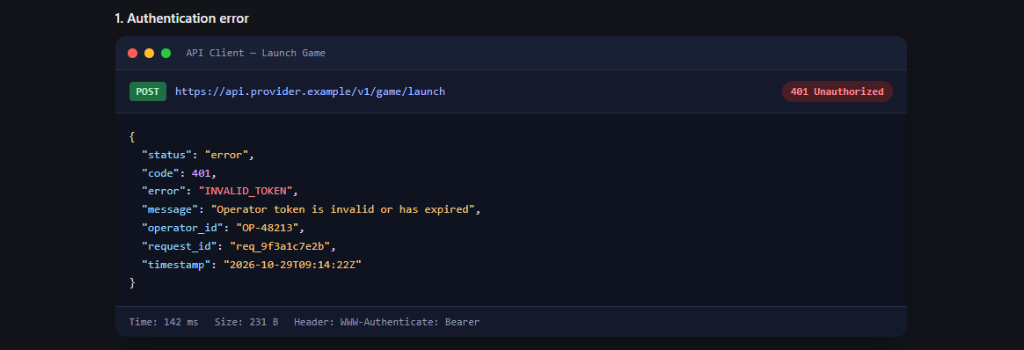
These happen when the API key, token, or operator ID is wrong or expired. The player cannot even launch the game. According to the OWASP API Security Top 10, broken authentication is one of the biggest API risks, so handle it carefully.
Timeout Errors
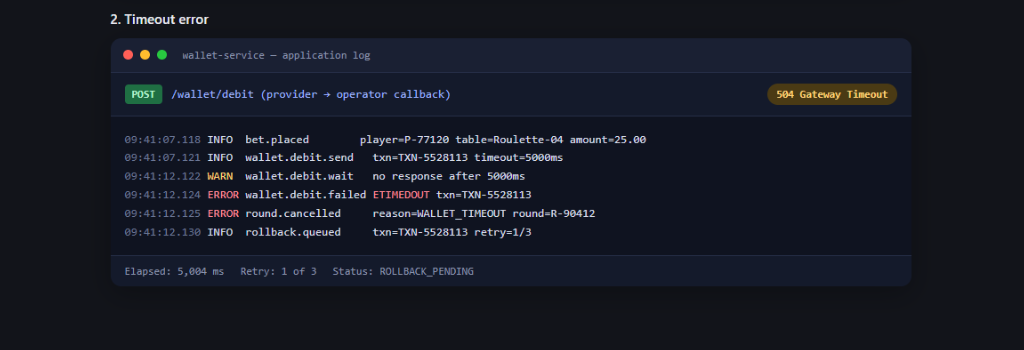
Your wallet or the provider did not reply in time. This is the most common error in real-time games.
Wallet and Balance Errors
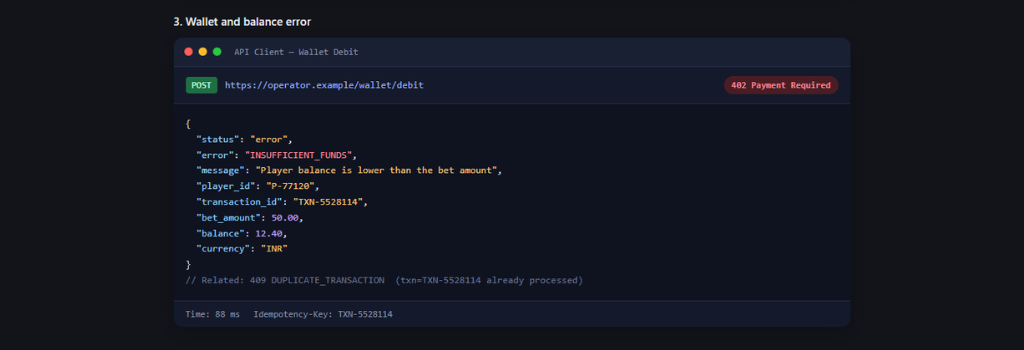
Examples are insufficient funds, duplicate transactions, or a failed credit after a win. This is the most sensitive area because it touches real money.
Session and Game Launch Errors
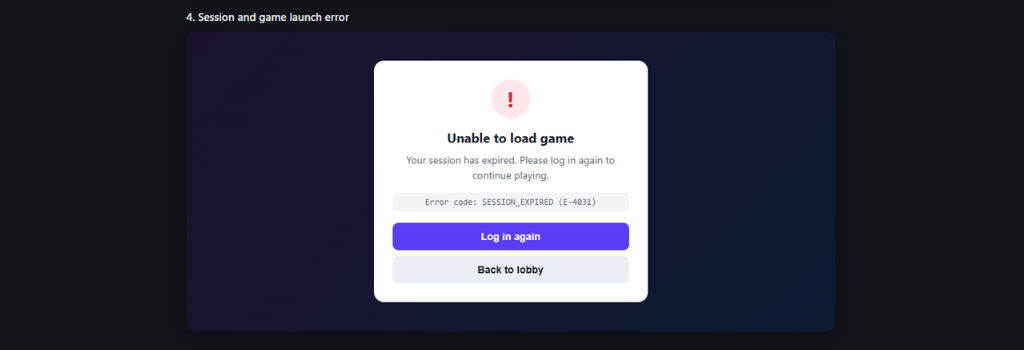
Expired player sessions, wrong currency, or blocked regions can stop the game from loading.
Server Errors (5xx)
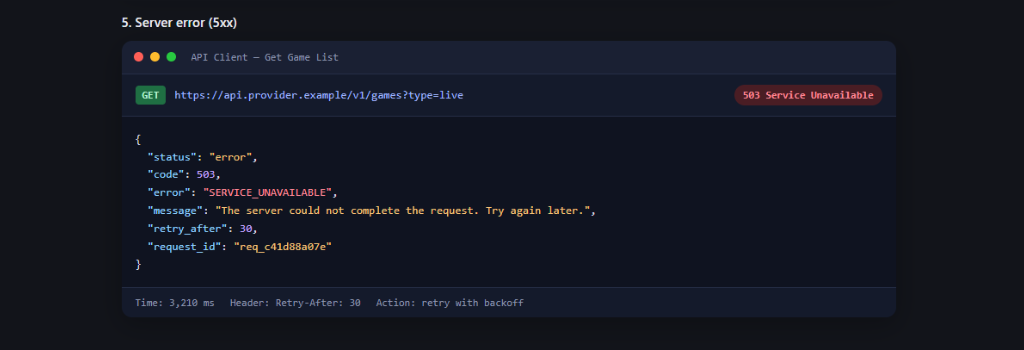
According to the IETF's RFC 9110, 4xx codes mean a client-side problem, and 5xx codes mean the server failed to complete a valid request. This basic split helps your team decide: fix the request, or retry later.
How to Build a Fault-Tolerant Ezugi Integration
Here are the steps that a good casino API integration should follow.
1. Use Smart Retries With Backoff
Do not retry again and again at the same second. Use exponential backoff, which means waiting a little longer after each failed try, and add a small random delay. The Google SRE Book recommends this approach to avoid overloading a system that is already struggling.
Example: A player wins a Blackjack hand, and your wallet credit fails with a timeout. Your system retries after 1 second, then 2, then 4, and stops after a fixed limit. If it still fails, the transaction goes to a manual review queue.
2. Make Wallet Calls Idempotent
Idempotent means the same request can be sent many times, but it is processed only once. Every bet, win, and rollback should have a unique transaction ID. Your system checks that ID first.
Example: Ezugi sends a debit callback twice due to a network glitch. With a unique ID check, your wallet debits the player only once.
3. Plan for Rollbacks
If a bet is debited but the round fails, the money must go back to the player. Keep a clear rollback flow and log every step. Do not leave a bet in a "pending" state forever.
4. Add Circuit Breakers
A circuit breaker stops sending requests to a service that keeps failing. It gives the service time to recover and protects the rest of your platform.
5. Set Proper Timeouts
Set timeouts for each call. A call that hangs for 30 seconds is worse than a call that fails in 3 seconds and gets retried.
6. Show Clear Messages to Players
Do not show raw error codes. Use simple messages like "Table is not available right now. Please try another table." This keeps trust high.
7. Build Monitoring and Alerts
Track error rate, response time, failed wallet calls, and stuck rounds. Set alerts so your team knows before the players complain.
8. Keep Secure Logs
Log request IDs, timestamps, and error types. Do not store sensitive data like full tokens or payment details in logs.
Error Handling Checklist for Operators
Even if you are a non-technical founder, you can ask these questions to your tech team or your provider. They are also useful when you compare the leading Ezugi live casino game providers, because technical support quality is as important as game content.
-
Are all wallet calls idempotent?
-
What happens if the callback fails or comes twice?
-
Is there an automatic rollback for failed rounds?
-
Do we have a live dashboard for errors?
-
Is there a backup plan if the live stream goes down?
-
Has the integration been tested with failure cases, not only the happy path?
Testing Before Launch
Most teams test only when everything works. That is a mistake. Test with slow responses, duplicate callbacks, expired tokens, and wallet downtime. Load test your system at peak traffic too. Many errors only show up when hundreds of players bet in the same round.
Choosing the Right Integration Partner
Error handling quality depends a lot on your provider and development partner. Before you sign, check their documentation, sandbox support, and how fast they respond to issues. A good partner will also share how they handle failed rounds, wallet mismatch, and downtime, instead of only talking about game content.
Why Choose Orion InfoSolutions for Live Casino API Integration?
Developing a stable live casino platform is not an easy task. You need a team that understands both game logic and payment safety. Orion InfoSolutions builds casino and iGaming solutions with secure wallet flows, tested error handling, and end-to-end support, so your platform stays stable even during peak traffic.
Contact our expert consultants or visit our website to know more about us.
Conclusion
Ezugi API error handling decides whether your live casino feels smooth or broken. Smart retries, idempotent wallet calls, rollbacks, circuit breakers, and proper monitoring make your integration fault-tolerant and protect both your players and your revenue. Plan for failures from day one, and your platform will be ready when real traffic arrives.
Categories
- Sports
- Sports Website
- Fantasy
- Betting
- Software
- Software tools
- Artificial intelligence
- Machine learning
- Programming
- JavaScript
- Digital Marketing
- Marketing analytics
- Mobile marketing
- SEO
- Cryptocurrency
- Decentralized Application (dApp)
- Smart Contract
- Blockchain Security
- Blockchain Software
- Website Development
- Front-end Web
- Back-end Web
- Full-stack Web
- Web Development Software
- Web Services
- Web Development Trends
- eCommerce
- Mobile App Development
- Hybrid App
- Cross-platform App
- Android App
- iOS App
- E-commerce App
- Social Networking App
- Health and Fitness App
- Education App
- Travel and Tourism App
- Food and Drink App
- Entertainment App
- Productivity App
- Utility App
- Fantasy App
- Wearable Device
- PhoneGap
- Dating App
- Real Money App
- Game Development
- Puzzle games
- Board games
- Card games
- Casino games
- AR and VR games
- Multigaming



My Name is DC Kumawat. I am CEO of Orion InfoSolutions, a leading provider of game development solutions to businesses of all sizes. I keep a strong focus on the new technologies that are driving our digital world. As an IT entrepreneur, I believe that it is my mission to break down these difficult market changes into useful insights for my community.