Ezugi API Webhooks Explained: Building Real-Time Casino Transaction Processing
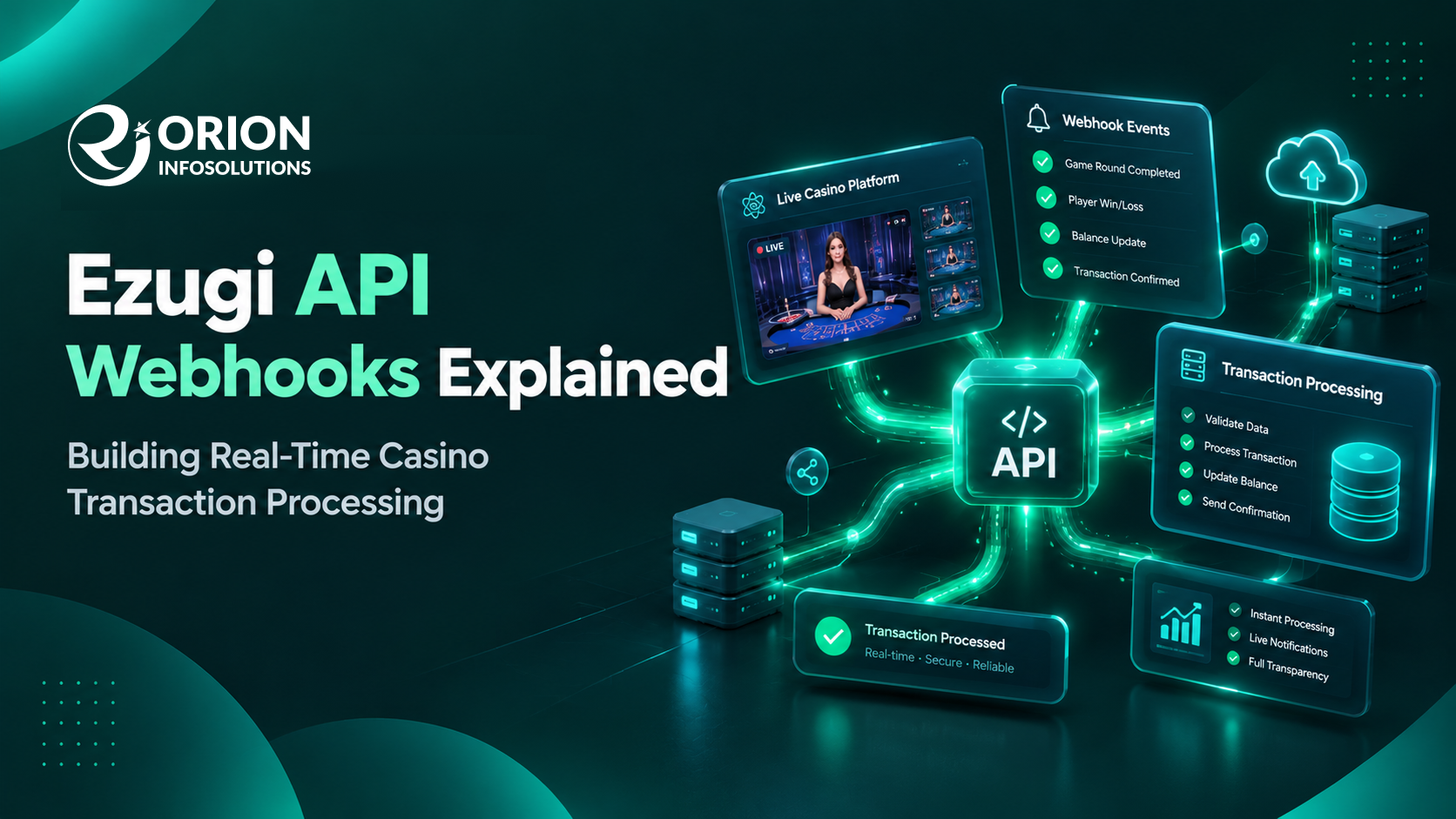
Running a live casino platform means one thing above everything else: every bet, win, and refund must reach the right player wallet at the right time. If one transaction goes missing in a live Blackjack or Roulette round, the player notices immediately, and so does your support team.
This is where Ezugi API webhooks come into the picture. Many operators and startup founders hear the word "webhook" during onboarding but don't get a clear explanation of how it works. In this blog, we will explain it in simple words, with examples, so both technical and non-technical readers can understand it.
What Are Ezugi API Webhooks?
A webhook is an automatic message sent from one system to another when something happens. In a live casino setup, the game provider sends a message to your server whenever a player places a bet, wins a round, or a round gets cancelled.
Ezugi is a well-known live dealer studio that became part of Evolution in 2018, according to Evolution's investor information. Its games are connected to operators through an API-based integration, and the real-time communication between Ezugi and your platform runs on these callbacks. If you want a broader view of what the provider offers, our guide on Ezugi API solutions explains the full package.
Simple example: A player sits at a live Roulette table and bets $10. Ezugi sends a request to your callback URL saying "debit $10 from this player." Your server checks the balance, deducts the money, and replies with the updated balance. All of this happens in a few hundred milliseconds, before the dealer spins the wheel.
How Does Real-Time Casino Transaction Processing Work?
Most live casino providers use a seamless wallet model. This means player money stays in your system, and the provider asks your server to approve or change the balance every time. You don't have to transfer funds in and out of the game provider's wallet.
The flow looks like this:
-
The player opens a game from your lobby.
-
Ezugi sends an authentication request to verify the player session.
-
The player places a bet, and Ezugi sends a debit request.
-
The round finishes, and Ezugi sends a credit request for winnings.
-
If something fails, Ezugi sends a rollback or cancel request.
Note: The exact endpoint names, field names, and response formats are given in Ezugi's official documentation during onboarding. The names above are the commonly used wallet actions in seamless wallet integrations, so always follow the documents shared with your account.
The Main Webhook (Callback) Types You Should Know
Here are the typical wallet events your platform has to handle:
-
Authenticate: Confirms the player token and returns player details and balance.
-
Debit (Bet): Deducts the bet amount from the player wallet.
-
Credit (Win): Adds the winning amount after the round result.
-
Rollback: Reverses an earlier debit when a round is cancelled or a bet fails.
-
Balance check: Returns the latest wallet balance to show in the game screen.
Each of these needs a clear response in the format the provider expects. If your server answers with the wrong format, the provider may treat the request as failed and try again.
Why Idempotency Is the Most Important Thing
Webhooks can be sent more than once. A network timeout, a slow database, or a retry from the provider can make the same debit request arrive two times. If your system processes both, the player loses money twice, and that becomes a dispute.
The fix is called idempotency. Store the unique transaction ID from every request. If the same ID comes again, don't process it again. Just return the same response as before.
Example: Ezugi sends a debit of $10 with transaction ID TX1001. Your server deducts it, but the response gets lost on the way. Ezugi retries with TX1001. Your server sees the ID already exists, skips the deduction, and sends back the same success response. The player is charged only once.
This is also why a proper error-handling plan matters. We have covered retries, timeouts, and failure scenarios in detail in our blog on Ezugi API error handling.
How to Secure Your Ezugi Webhook Endpoints
Your callback URL is open to the internet, which means anyone can try to hit it. Casino wallets are a high-value target, so security can't be an afterthought.
Follow these basics:
-
Use HTTPS only: Never accept wallet requests over plain HTTP.
-
Validate the signature or hash: Check that the request is truly from the provider using the shared secret. Signature methods like HMAC are defined in RFC 2104 by the IETF.
-
Whitelist IP addresses: Allow only the IPs shared by the provider.
-
Reject old requests: Check timestamps to avoid replay attacks.
-
Log everything: Keep a full record of each request and response for audits and dispute handling.
The OWASP API Security Top 10 lists common risks like broken authentication and unrestricted resource access, and it is a good checklist to test your wallet endpoints against.
Response Time and HTTP Status Codes Matter
Live casino rounds are fast. If your server takes too long, the bet may fail, and the player will see an error at the table. So keep your wallet database queries light and your server close to the provider's region where possible.
Also, return correct HTTP status codes. The meanings of codes like 200, 400, and 500 are defined in RFC 9110, and mixing them up can make retry logic behave in unexpected ways.
Compliance and Audit Trail
If you are planning to operate in a licensed market, wallet records are not only a technical need. Regulators such as the UK Gambling Commission have remote technical standards that cover things like accurate transaction records and fair game operation. Keeping clean logs of each debit, credit, and rollback makes your audits much easier.
Common Mistakes Operators Make with Webhooks
-
Processing duplicate requests without checking transaction IDs
-
Not handling rollback for a debit that never arrived
-
Sending slow responses because of heavy database queries
-
Skipping signature validation on the staging environment, then forgetting to enable it in production
-
Testing only the success flow and ignoring failures
Webhooks Are One Part of the Full Integration
Ezugi webhooks work together with game launch, session handling, reporting, and back-office tools. If you want to see how the whole structure fits together, our casino API integration guide covers it step by step. And if you are still comparing studios before you decide, take a look at the list of Ezugi and other live casino game providers to understand where Ezugi stands.
How Orion InfoSolutions Can Help
Building a wallet layer that handles thousands of live transactions without errors is not easy, especially for startups launching their first platform. Orion InfoSolutions is an experienced casino game and API integration company that helps operators with Ezugi API integration, seamless wallet setup, secure callback handling, testing, and post-launch support. Whether you are a technical team or a non-technical founder, we explain every step in a simple way and deliver on schedule.
Contact our expert consultants or visit our website to discuss your Ezugi API project.
Conclusion
Ezugi API webhooks are the backbone of live casino transaction processing. When your authentication, debit, credit, and rollback callbacks are fast, secure, and idempotent, players get a smooth experience, and your business gets clean, trustworthy financial records. Get this part right before launch, and you will save yourself from many wallet disputes later.
Categories
- Sports
- Sports Website
- Fantasy
- Betting
- Software
- Software tools
- Artificial intelligence
- Machine learning
- Programming
- JavaScript
- Digital Marketing
- Marketing analytics
- Mobile marketing
- SEO
- Cryptocurrency
- Decentralized Application (dApp)
- Smart Contract
- Blockchain Security
- Blockchain Software
- Website Development
- Front-end Web
- Back-end Web
- Full-stack Web
- Web Development Software
- Web Services
- Web Development Trends
- eCommerce
- Mobile App Development
- Hybrid App
- Cross-platform App
- Android App
- iOS App
- E-commerce App
- Social Networking App
- Health and Fitness App
- Education App
- Travel and Tourism App
- Food and Drink App
- Entertainment App
- Productivity App
- Utility App
- Fantasy App
- Wearable Device
- PhoneGap
- Dating App
- Real Money App
- Game Development
- Puzzle games
- Board games
- Card games
- Casino games
- AR and VR games
- Multigaming



My Name is DC Kumawat. I am CEO of Orion InfoSolutions, a leading provider of game development solutions to businesses of all sizes. I keep a strong focus on the new technologies that are driving our digital world. As an IT entrepreneur, I believe that it is my mission to break down these difficult market changes into useful insights for my community.